
Home > Industrial PLC Migration: IESA Modernizes a Tire Manufacturing Facility
Home > Industrial PLC Migration: IESA Modernizes a Tire Manufacturing Facility
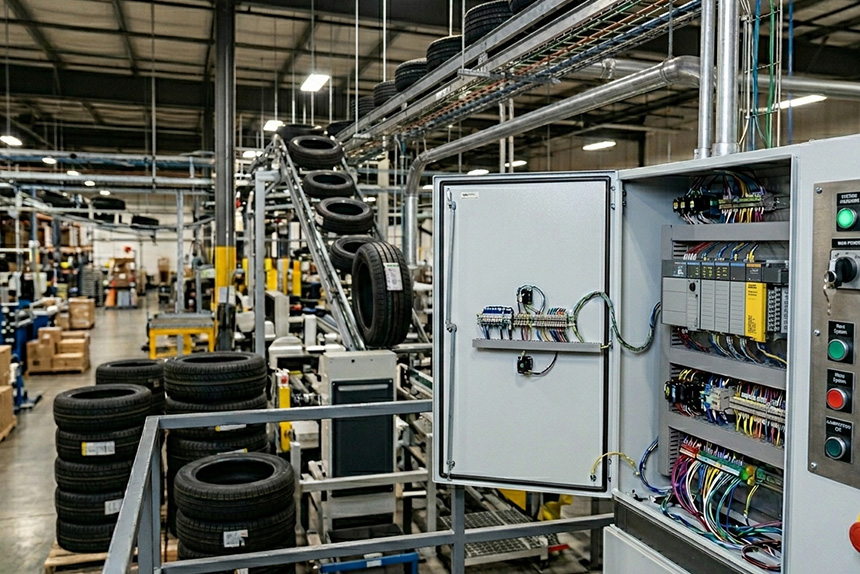
In industry, upgrading a control system involves much more than replacing an aging PLC with newer technology. It requires anticipating interactions across the entire process, securing software development, preparing the electrical installation, and validating as much as possible before production resumes.
IESA has recently been awarded a new project for a major player in the tire manufacturing industry. The project will bring together several of our areas of expertise with one common objective: carrying out an industrial PLC migration and modernizing the installation while minimizing the risks associated with the final switchover.
Upgrading an existing industrial installation presents very different challenges from designing a new system.
Engineering teams must work with:
For this project, the final switchover and commissioning of the new equipment will have to be completed during a production shutdown lasting just four days.
This constraint makes thorough preparation and validation before the shutdown essential.
IESA will support the project across both industrial automation and industrial electrical engineering, from initial engineering studies through installation and on-site commissioning.
The scope of work includes:
This comprehensive approach allows the installation to be treated as one integrated system rather than as a series of isolated upgrades.
One of the central elements of the project is the migration from SLC500 PLCs to a ControlLogix architecture.
An industrial PLC migration goes far beyond simply converting an existing program.
Engineering teams must analyze how the current installation operates, understand its control logic, and adapt that logic to the new architecture while incorporating the customer’s latest programming standards.
The programs will therefore be rewritten to provide a control architecture aligned with the site’s current technical requirements.
The goal is to achieve a successful technology transition while maintaining full control over the process functions.
The modernization project also includes changes to communication between the different pieces of equipment.
The existing Profibus-ASi fieldbus will be replaced by an Ethernet-ASi architecture.
This change must be taken into account throughout the automation engineering, electrical preparation, and equipment configuration phases.
In an industrial retrofit project, these interfaces are critical: all components must communicate correctly when the process is restarted.
IESA’s combined expertise in automation, industrial networks, and electrical engineering makes it possible to manage these changes within one integrated control-system approach.
Modernizing an industrial installation also means updating its technical documentation.
As part of this project, the existing electrical drawings created in Xelec will be converted to SEE Electrical.
This will align the documentation with the tools and engineering standards currently used by the customer.
It will also make the installation easier to maintain and upgrade in the future by providing electrical documentation that accurately reflects the newly installed equipment.
When commissioning must take place within a very limited shutdown window, upstream testing becomes particularly important.
By connecting the simulator to the automation system, engineers can virtually reproduce the behavior of the operating equipment and test the PLC programs against a wide range of operating scenarios.
This makes it possible to:
At IESA, industrial simulation and virtual commissioning have progressively become fully integrated engineering tools within automation projects.
A Factory Acceptance Test (FAT) phase will also be carried out with the customer.
These tests make it possible to validate the project’s key functions before the final deployment on site.
Combined with industrial simulation, FAT plays a major role in preparing the final switchover: the more system behavior can be validated beforehand, the more the on-site teams can focus on the operations that truly require access to the production equipment.
The final phase will be one of the project’s most demanding stages.
IESA teams will handle:
All of these operations must be completed during a four-day production shutdown.
A project of this kind therefore relies on one essential principle: prepare as much as possible before production stops.
Engineering studies, PLC programming, electrical drawing conversion, electrical preparation, simulation, and FAT all help secure the project before the shutdown window begins.
This new project illustrates the complementary expertise IESA brings to industrial modernization and retrofit projects.
Our teams support industrial companies throughout the entire project lifecycle:
This ability to combine multiple technical disciplines is particularly valuable when modernizing existing installations, where a change to one part of the system can affect the entire process.
With many years of experience in the tire manufacturing industry, IESA supports customers in France and internationally with the modernization, optimization, and evolution of their production systems.
Do you have an industrial PLC migration, control-system retrofit, or industrial modernization project?
IESA teams can support you from the initial engineering phase through final commissioning.