
Home > Functional Safety: IESA Strengthens Its Expertise with Quali-SIL Certification
Home > Functional Safety: IESA Strengthens Its Expertise with Quali-SIL Certification
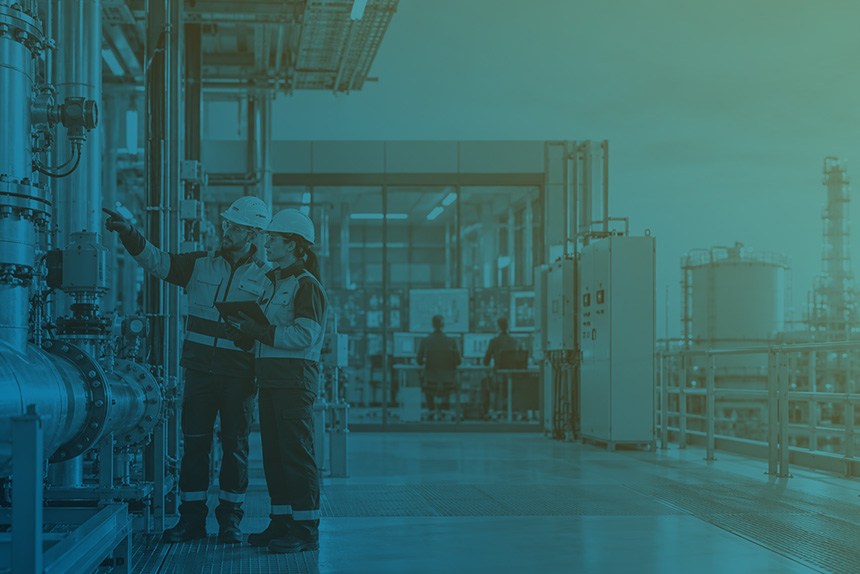
In industry, the performance of an automated system is not only based on its ability to efficiently control a process. For certain installations, it must also be able to detect hazardous situations and trigger the appropriate actions to bring the process into a safe state.
This is the purpose of functional safety, a field where technical expertise and a strong understanding of international standards are essential.
As part of its continuous training approach, IESA’s Technical Director has recently obtained the Quali-SIL Functional Safety Engineering certification, delivered by Ineris – the French National Institute for Industrial Environment and Risks.
This new certification further strengthens IESA’s technical expertise in the design and integration of industrial automation and control systems.
Functional safety refers to systems designed to perform a specific safety function when an identified risk occurs within an industrial installation.
Depending on the process, a hazardous situation may require actions such as:
These actions can be managed by Safety Instrumented Systems, commonly referred to as SIS.
A SIS generally combines several components – sensors, safety controllers and final elements – to monitor the process and activate a safety function when required.
Designing these systems requires a rigorous approach covering risk analysis, system architecture, programming, testing and validation of safety functions.
Functional safety is notably governed by two major international standards: IEC 61508 and IEC 61511.
IEC 61508 is the generic standard covering the functional safety of electrical, electronic and programmable electronic safety-related systems.
IEC 61511 applies these principles specifically to Safety Instrumented Systems used in the process industry.
These standards introduce the concept of SIL – Safety Integrity Level.
A SIL defines the level of risk reduction required for a Safety Instrumented Function. Determining the appropriate SIL is based on the risks associated with the process and the potential consequences of a failure.
Understanding and applying these standards is therefore essential when designing, integrating and maintaining safety-related industrial systems.
The Quali-SIL Functional Safety Engineering certification obtained by IESA’s Technical Director validates and strengthens several key areas of expertise:
This additional expertise complements IESA’s multidisciplinary capabilities in [industrial automation], control systems, supervision, [electrical engineering], [process simulation] and industrial IT.
Industrial systems are constantly evolving. New automation architectures, digital transformation, cybersecurity, safety requirements and changing standards all require engineering teams to continuously update their skills.
At IESA, continuous employee training is therefore a key part of maintaining a high level of technical expertise.
Regular training helps teams to:
This approach directly contributes to the value IESA delivers to its industrial customers.
Technical know-how alone is not always enough. It must also be supported by a detailed understanding of the process, the constraints of the installation and the standards applicable to each project.
IESA provides expertise in PLC programming, supervision, electrical engineering, process simulation and industrial IT for complex control system projects in France and internationally.
Functional safety skills further strengthen this multidisciplinary approach.
They help ensure that safety requirements can be considered throughout the different stages of a project: engineering studies, design, development, testing, validation and commissioning.
This ability to combine technical expertise is particularly important in industrial sectors where production performance, plant availability and safety requirements must all be addressed simultaneously.
IESA operates in a wide range of industries, including food processing, aluminium, environment, [nuclear], Oil & Gas, glass, logistics, mining, marine, tunnelling and cable transport.
This Quali-SIL certification is part of a broader commitment: continuously developing the expertise of IESA’s teams to meet the technical and regulatory requirements of industrial projects.
For IESA, investing in training means strengthening technological expertise, improving knowledge of international standards and enhancing the ability to design control solutions for demanding industrial environments.
Expertise is never static. It evolves alongside technologies, standards and the new challenges facing industry.